
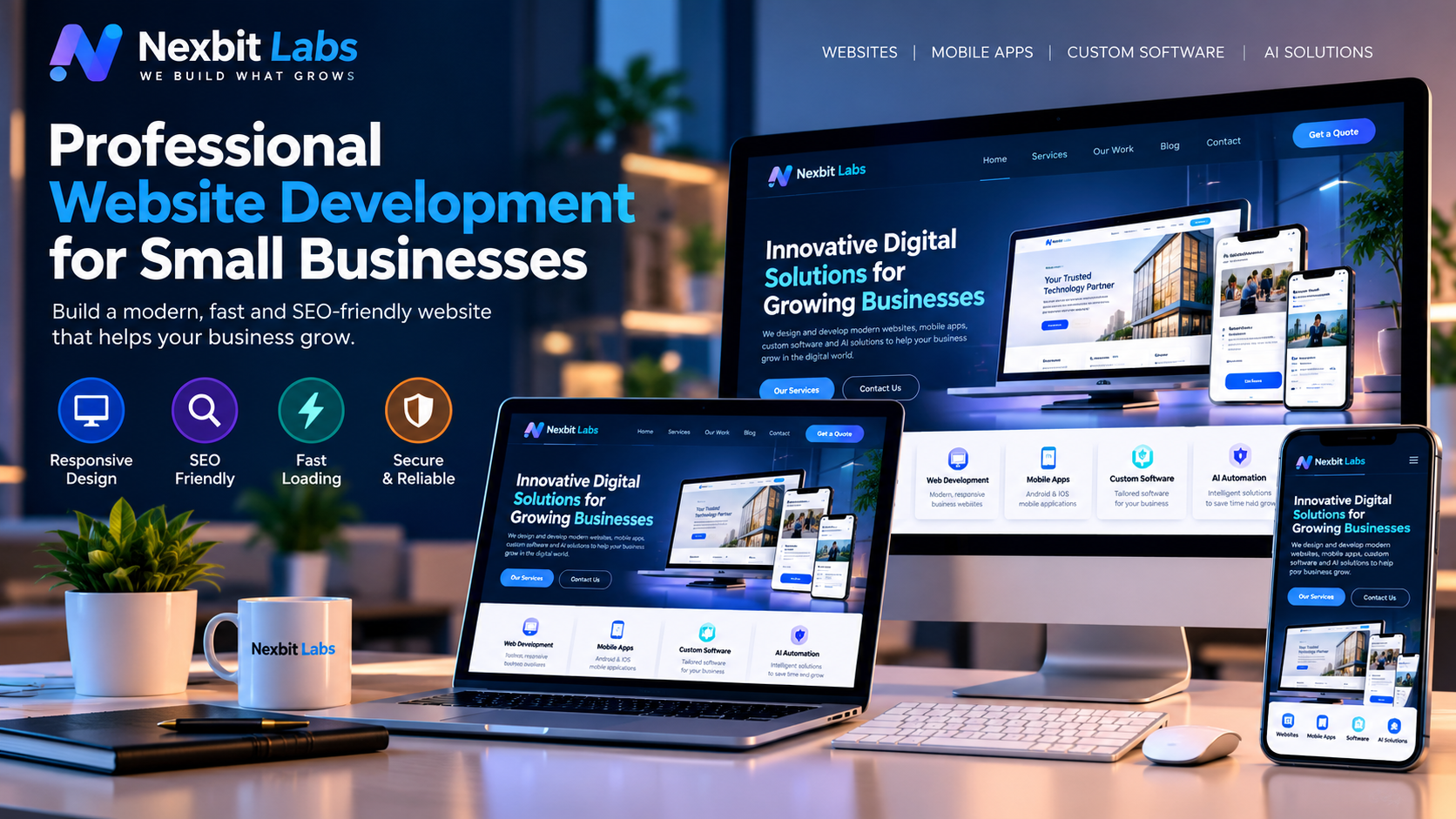
In today's digital world, having a professional website is no longer just an advantage for a business. It is one of the most important ways to establish credibility, reach potential customers and communicate what your business offers.
Whether you operate a small retail shop, consulting business, educational institution, restaurant, service company or growing startup, a well-designed website helps customers discover your business and contact you more easily.
But building a successful website involves much more than choosing attractive colours and uploading a few pictures.
A good business website should be fast, mobile-friendly, easy to navigate, secure and designed around your business goals.
In this guide, we explain everything small-business owners should understand before investing in website development in 2026.
1. Why Does Every Small Business Need a Website?
Many small businesses depend entirely on social media, WhatsApp or referrals to attract customers.
These channels are valuable, but they should not be your business's only digital presence.
A website gives your business a central online destination where potential customers can learn about your products, services and company.
Key benefits of having a professional website
Builds customer trust: A professionally presented website helps customers understand that your business is established and accessible.
Makes your business easier to discover: Search-engine-friendly content gives your business an opportunity to appear in relevant searches.
Provides information 24/7: Customers can review your services, pricing information, operating hours and contact details at any time.
Generates enquiries: Contact forms, enquiry buttons and WhatsApp integration make it easier for interested visitors to reach you.
Supports business growth: Your website can be expanded with booking systems, online payments, customer portals or other features as your requirements evolve.
A website should not simply exist to look attractive. It should help visitors understand your business and take the next step.
2. Different Types of Websites for Small Businesses
Not every business requires a complicated website. Choosing the right type helps you avoid paying for features you do not need.
Basic Business Website
A basic business website introduces your company, services, location and contact information.
It commonly includes a homepage, About Us section, services information and contact options.
Best for: Local businesses, freelancers, consultants, small agencies and new companies.
Professional Multi-Page Website
A multi-page website provides dedicated pages for individual services, projects, FAQs and other business information.
This structure can support better navigation and more focused search-engine optimization.
Best for: Service providers, construction companies, educational institutions, healthcare practices and growing businesses.
E-Commerce Website
An e-commerce website enables businesses to display products, manage orders and accept online payments.
Depending on the requirements, it may include product categories, inventory management, shopping carts, payment integration and delivery information.
Best for: Retailers, product brands, specialty stores and businesses planning to sell online.
Booking and Appointment Website
Some businesses need more than a contact form.
An appointment website can allow customers to request or book consultations, select available services and receive booking confirmations.
Best for: Consultants, salons, training centres, professional services and appointment-based businesses.
Custom Business Web Application
When a business requires customer accounts, dashboards, approvals, reports or complex workflows, a custom web application may be more appropriate than a traditional website.
Best for: Businesses that want to digitize operations or build specialized online platforms.
3. Essential Features Every Professional Website Should Have
Regardless of the type of website, several fundamentals contribute to a good user experience.
Mobile-Responsive Design
Many customers browse websites using smartphones.
A mobile-responsive website automatically adapts its layout to different screen sizes, making information easier to read and navigation easier to use.
Buttons, forms, menus and images should work comfortably on mobile devices as well as desktop computers.
Fast Loading Speed
Visitors may leave a website if its pages take too long to load.
Optimized images, efficient code, appropriate hosting and sensible caching can improve loading performance.
Clear Navigation
Visitors should be able to find important information without searching through confusing menus.
Service details, company information and contact options should be easy to locate.
WhatsApp and Contact Integration
For many Indian businesses, WhatsApp is an important customer communication channel.
A properly configured WhatsApp button can help visitors start a conversation with your business.
Contact forms, phone links and email options provide additional ways to enquire.
HTTPS and Security
A website should use a valid SSL certificate and HTTPS.
Depending on the platform, ongoing security also involves appropriate software updates, access controls, backups and maintenance.
Search-Engine-Friendly Structure
Clear page titles, headings, descriptive content, internal links and appropriate metadata help search engines understand a website.
These are important foundations for SEO, although rankings also depend on competition, content quality and other factors.
4. What Is SEO-Friendly Website Development?
SEO stands for Search Engine Optimization.
SEO-friendly website development means building a website with a technical and content structure that helps search engines crawl, understand and potentially display its pages for relevant searches.
For example, a business offering website development services would want its service pages to clearly explain what it offers, who the services are intended for and how customers can enquire.
Important SEO considerations include:
Relevant, descriptive page titles and meta descriptions.
A clear heading structure using H1, H2 and H3 elements appropriately.
Helpful, original content that answers customer questions.
Descriptive URLs and logical internal navigation.
Mobile-friendly layouts and reasonable page-loading performance.
Image optimization and meaningful alternative text.
Canonical URLs, XML sitemaps and appropriate indexing settings.
Location-specific information when a business serves particular geographic areas.
SEO should be considered during website planning, not added only after the website is finished.
However, no legitimate website developer can guarantee a first-page Google ranking simply by building a website.
Good technical foundations support SEO, while consistent improvements and useful content help strengthen long-term visibility.
5. How Much Does Website Development Cost in India?
Website development costs vary significantly depending on the project's requirements.
A simple informational website generally requires less development work than a large e-commerce store or a custom application.
The major factors affecting cost include:
Number of pages: A single-page business website typically involves less work than a large multi-page website.
Design requirements: Customized layouts, animations and unique interactive features can increase development effort.
Business functionality: Appointment booking, customer login, payments, dashboards and administrative tools require additional development.
Content preparation: Writing service descriptions, preparing images and organizing business information may involve additional work.
Hosting and domain: A domain name, hosting, email service and SSL configuration can affect the total setup and recurring costs.
Maintenance and support: Website updates, backups, ongoing improvements and technical support should be discussed separately.
Rather than choosing a developer based only on the lowest advertised price, business owners should ask exactly what is included in the quotation.
A clear proposal should explain the website's scope, expected deliverables, timeline and any recurring expenses.
6. Custom Website vs Website Builder: Which Is Better?
Website builders can be useful for individuals and businesses that need a straightforward online presence and are comfortable using predefined templates.
They may offer convenient setup options and bundled services.
However, some businesses require more flexibility than a standard template provides.
A website builder may be suitable when:
Your requirements are simple.
You prefer managing a website yourself.
Standard templates provide the necessary features.
You do not need complex business integrations.
Custom development may be suitable when:
You need a distinctive brand presentation.
Your business has specialized requirements.
You want custom booking, payment or management functionality.
You expect to integrate the website with other systems.
You need greater control over how particular features work.
There is no single best approach for every business.
The right choice depends on your budget, technical requirements, expected growth and long-term plans.
7. Common Website Development Mistakes to Avoid
Many businesses spend money creating a website but overlook the details that influence its usefulness.
Here are some common mistakes:
Choosing design over usability: An attractive website is valuable, but visitors must also be able to understand your services and contact you.
Ignoring mobile users: A desktop-friendly website may still be difficult to use on a phone.
Using unclear content: Visitors should not have to guess what your business offers.
Forgetting the call to action: Every important page should provide a sensible next step, such as requesting a quotation or contacting the business.
Ignoring security and maintenance: A website requires appropriate care after launch.
Expecting instant SEO results: Organic visibility usually requires ongoing work rather than a one-time configuration.
Not confirming ownership and access: Before development begins, clarify ownership of the domain, hosting, content and relevant accounts.
Avoiding these mistakes can make your website a more dependable business asset.
8. A Step-by-Step Website Development Process
Understanding the development process makes it easier to communicate with your developer and evaluate progress.
Step 1: Identify Your Business Goal
Decide what your website should achieve.
For example, your goal may be to attract enquiries, display a product catalogue, accept bookings or explain your services.
Step 2: Define the Required Pages and Features
Prepare a list of essential pages and functionality.
Separate features you need immediately from those that can be added later.
Step 3: Plan the Design and Navigation
Choose a structure that clearly communicates your brand, services and contact information.
Step 4: Develop the Website
The website is built according to the agreed requirements, with appropriate layouts, interactive elements and integrations.
Step 5: Test Before Launch
Review the website on smartphones and desktops.
Check important links, forms, buttons, navigation, images, loading behaviour and contact methods.
Step 6: Launch and Maintain
After testing, the website can be made publicly accessible.
Ongoing maintenance may include updates, content improvements, backups, security checks and SEO work.
9. How Nexbit Labs Helps Businesses Build Better Websites
At Nexbit Labs, we focus on developing digital solutions around practical business requirements.
We understand that business owners may know what they want their website to achieve without knowing every technical detail.
Our approach begins by understanding the business, its customers and the functionality required.
Depending on the project, website development can include:
Business websites and landing pages.
Professional multi-page websites.
Mobile-responsive website design.
E-commerce development.
WhatsApp and contact-form integration.
Booking and management systems.
Custom dashboards and business applications.
Backend development and API integrations.
SEO-friendly page structure and technical foundations.
We also offer a Nexbit AI Project Assistant to help business owners organize their requirements before discussing a suitable solution with our team.
This can be useful when you have an idea but are unsure how to describe the technical features.
Explore our Website Development Services to learn more.
10. Frequently Asked Questions About Website Development
How long does it take to develop a business website?
Development time depends on the website's size, design requirements, availability of content and technical features.
A small informational website may require less time than an e-commerce platform or a custom business application. A realistic timeline should be agreed upon after reviewing the requirements.
Can my website work on mobile phones?
Yes. A professionally developed responsive website can be designed to work across modern smartphones, tablets and desktop screens.
Mobile usability should be checked during testing rather than assumed.
Can customers contact me directly through WhatsApp?
Yes. A website can include a WhatsApp contact button that opens a conversation with your business number.
More advanced WhatsApp integrations may require additional services or approved messaging APIs.
Will my new website appear on Google?
A properly configured website can be made eligible for search-engine discovery and indexing.
Actual indexing and ranking are controlled by search engines and are not guaranteed. Helpful content, technical quality and ongoing SEO efforts can improve your website's prospects.
Can I add more features to my website later?
Often, yes. Additional pages, contact features, booking systems or other functionality can be developed as your business grows.
The ease of expansion depends on the website's original architecture and the new requirements.
Final Thoughts: Build a Website That Supports Your Business
A business website is more than an online brochure.
When thoughtfully planned, it can help visitors understand your services, communicate with your team and develop confidence in your business.
Whether you are launching your first website or improving an existing one, focus on usability, performance, security, clear content and long-term flexibility.
The objective should be to create a website that serves your customers and supports your actual business goals.
Ready to Build Your Business Website?
Nexbit Labs can help you plan and develop a website based on your business requirements.
You do not need to prepare a complicated technical document before contacting us.
Tell us about your business, what you want your website to do and any important features you have in mind.
Our team can review your requirements and discuss an appropriate solution.
Explore Website Development Services
Published by Nexbit Labs — Website Development, Custom Software & Digital Business Solutions.